
Where’s the Chef?
Fine Dining’s Hidden Illusion

I have recently come across a post on my Instagram feed. The person I follow shared a reply from a top sushi venue in New York responding to a booking inquiry, saying they cannot guarantee chef’s presence on a specific day. Instead they suggest: “one of our amazing sushi chefs will take great care of your party”. Referring to this reply, he criticises a common issue in the fine-dining and sushi world (particularly in the States), where restaurants are awarded Michelin stars or enjoy immense success even when the head chef is absent. He argues that it is unethical for a restaurant to serve guests when the chef is absent. American diners, in his view, have too much money but not enough discernment, which allows this system to persist. He now avoids any restaurant whose chef is not present, insisting that either the restaurant should close or refund diners if the chef is away.
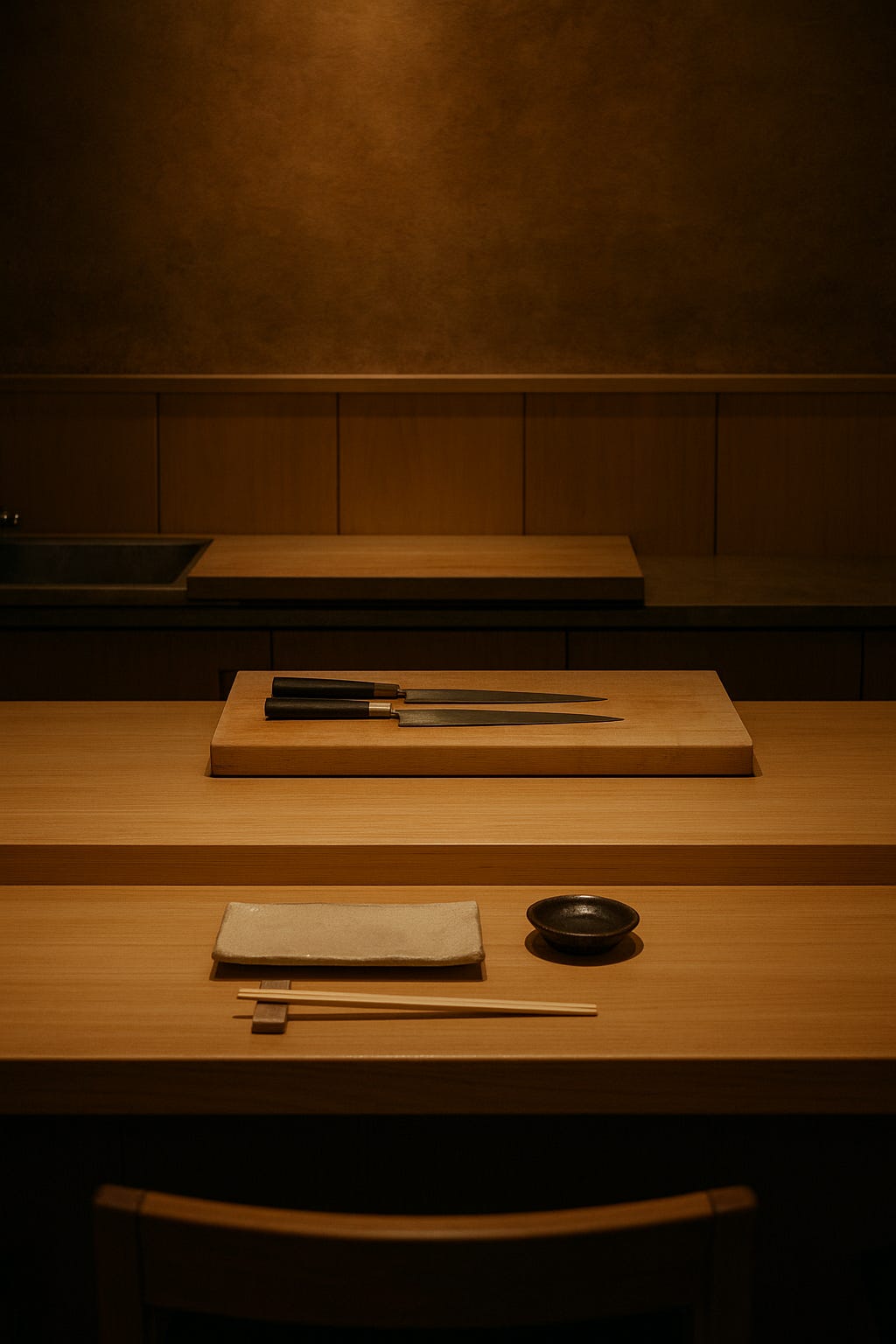
I think what is happening at that sushi restaurant in New York is not an isolated case; it is part of a global malaise. We first wrote about this back in the mid-2010s, when a new breed of “traveller chefs” emerged: constantly in transit, hopping from one pop-up to another, never in their own kitchens. The food world celebrated their omnipresence (or rather, their glamorous absence) while diners quietly paid the price.
Is it fair to the paying customer? Absolutely not. Yet the defenders of the status quo keep repeating that “these systems are good for the industry”. What they really mean is: they are good for the restaurant. In what sense? It is good for their business; good for their branding; and good for the myth-making. But at whose expense? The diner, of course. The paying guest becomes an accessory to the chef’s personal brand, not the beneficiary of their craft. This is what restaurant assessment systems like The World’s 50 Best Restaurants have perfected: the mass production of celebrity chefs who then ride the wave of fame, detached from their kitchens and the soul of their own cooking.
Someone then commented on my Instagram post that the main function of such chefs is to create dishes that can easily be executed by others. He argued that it was the paying customers’ sense of entitlement that made them complain about the chef’s absence. But this is a self-defeating logic: you build a brand on the illusion of presence, then call it entitlement when diners notice the absence. What hides beneath is a deeply unhealthy cycle. You create a celebrity chef who becomes the very reason people visit your restaurant, only for them to discover that their reason for visiting is not there. And the only thing keeping the place alive is the need to maintain that myth through PR and networking.
A chef’s presence in the restaurant is more than symbolic too. It is the final checkpoint of integrity. Every component that leaves the kitchen passes, directly or indirectly, through the filter of their judgment. The dish is not merely prepared; it is approved. If it falls short, it is made again. That moment of scrutiny (the pause, the look, the quiet nod or rejection, changes on the plate etc) is where a chef’s reputation truly resides. Everything else is marketing.
And let’s be clear: in the context of sushi, the absence of the master is not just disappointing; it is a betrayal. Sushi is a direct transmission from the hands of the itamae to the guest. Remove the master from that equation, and what is left is a simulation: a performance without presence, a meal without meaning.
The circumstances that Besim writes about reminds me of what happens when you go to a Broadway play or an opera when someone comes ot on stage and tells you that the lead actor or singer is “indisposed” and is being replaced by an understudy you never heard of. That this situation is happening with increasing frequency in dining’s upper echelons is disconcerting, and with the on-going dilutive nature of so-called fine dining, the opportunities of having a meal at the hands of the great chef are diminishing. As Besim stated, this becomes most glaring with sushi chefs, but why shouldn’t this be relevant to more conventional chefs, especially the ones who charge close to $1000 (or more) per person?
I go back a long way in my interest in, and the consuming of, blow-out meals. The phenomenon of what we are describing takes me back to Alain Chapel saying he became anxious about being away from his kitchen when he had to travel to America to cook at what were, for him, lucrative events. And when Pierre Gagnaire was in Saint-Etienne, he told me that after two days of being away, the quality of his restaurant suffered. Today with certain chefs, you are best off assuming the chef whose name is on the menu won’t be in residence. You will never see Alain Ducasse at the Louis XV in Monaco, and even if he were there, he wouldn’t be the one making the food. Jean-Georges puts his name on many restaurants, but when I go to the one close to where I live, I am likely the only one who knows there aren’t chefs in the kitchen, just like most cafes and brasseries in France. Let’s face it then: Restaurant cuisine is becoming increasingly like the automobile assembly line, even like the one at Rolls-Royce. With sous-vide and the new-fangled ovens that do away with the need for hands-on chefs with “thermometers in their heads”, the name-chef is not a chef as chefs used to be. Added to this is that restaurants by themselves are more often than not break-even or money-losing propositions, relegating owner-chefs to relying on outside sources to get by. I guess the remedy is to go to those diamonds in the rough where the chef isn’t famous, but will provide you a delicious meal, be it innovative in a personal way or the traditional tried-and-true that will all but guarantee that the chef won’t be going anywhere.
It's a thought provoking article. Loved it. And immediately thought about its relevance to my own industry, winemaking.
Consulting winemakers often have nothing to do with the actually process of winemaking. They may be simply pulled in after the wine is made according to a set of protocols and the consultant tastes the wine, then offers suggestions for adjustment. That's it. But it's a good living.
In other cases, the Assistant Winemaker does all the work and the Winemaker simply checks the work along the way, having been stuck in an office doing paperwork. Sort of a Master and Apprentice situation, this is probably the most common. The Assistant at some point will get hired away to do the same thing to someone else at their new gig. This has been the way for most systems around the world, along with Interns.
Another case, the "Winemaker" is merely a title, the individual knowing next to nothing about winemaking and having a production facility make their wine for them. If the wine gets praise, the "Winemaker" gets the glory, but the actual person who made it gets, well, nothing.